One of the reasons why I felt like quant was hollow was that money was always the final objective function.
- Doing RL with a final objective that was… money
- Marking to market every single day, marking to money
- Making every decision, only really thinking about… money. What we’re trading, what we provide liquidity in. All money, really.
Combine this over every firm in the industry, without appropriate regulation to mandate certain behaviors, and you end up with a functionally brittle system, that maximizes rebates for the CME at best, predatory behavior at worst.
And I have the privilege of an amazing education, so I can criticize this, sure! But I think the biggest thing for me is integration of that information. I have all these facts in my head, and all this knowledge but haven’t ever applied it. Now that AI exists, maybe that skill is a commodity. Or maybe it’s time to apply what I learned. One criticism I have of academia is the lack of real stakes in knowledge, you can understand how something works at a distance, but the human problems are too messy to fully integrate that knowledge into the world. And once you get into industry, things are too messy on the inside to do anything but survive.
Kalshi did something really cool, in my eyes–they used their elite knowledge of prediction markets to build something that people could use. They call it gambling, sure, but prediction markets do predict the outcome of events better than
Roger Myerson won a Nobel Prize for his work in mechanism design. How do we create mechanisms or institutions that work to maximize utility while incentivizing honest bidding. This solves the Principle-Agent problem. You can be cynical all you want of people’s full intentions, but under a game that incentivizes honest bidding, the results are least closer to societally optimal.
Take the example of a used car salesman. How can you get the information of whether a car is “good” or “bad,” given that the salesman has no incentive to give honest information?
Using Claude to help me out.
The core move
The principal can’t extract truth by asking, because the agent’s report is “cheap talk” — costless and unverifiable, so the agent just says whatever serves him. The trick of mechanism design is to make the report costly in a way that depends on the truth. The principal designs a set of rules (a game form) such that, given how the rules pay out, the agent’s own self-interest leads him to take an action only a particular type of agent would find worthwhile. The principal then reads the agent’s behavior, not his words.
The used-car example, worked out
Say a car is either Good (worth $10k to the buyer, reliable) or Bad (worth $4k, will break down). Only the seller knows which. If the buyer asks “is it good?”, every seller answers “good.” Useless.
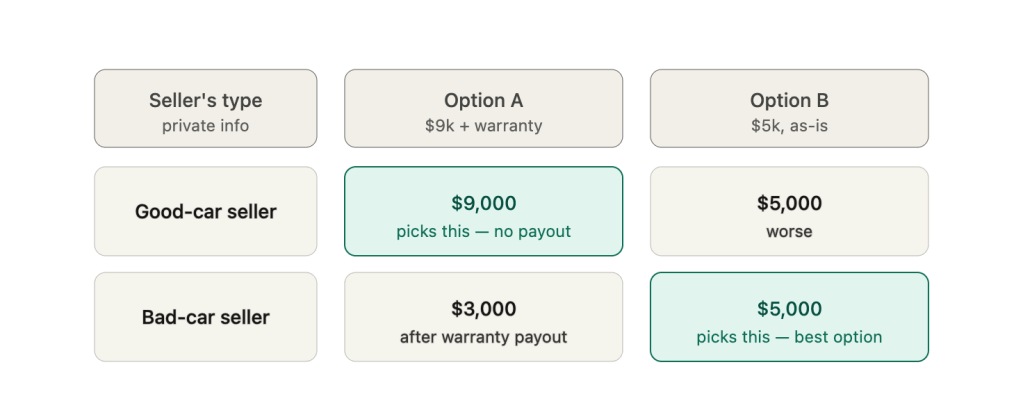
Now the buyer (the principal) instead offers a menu and lets the seller pick:
- Option A: Price $9,000, with a warranty — seller must refund $6,000 if the car breaks within a year.
- Option B: Price $5,000, sold “as-is,” no warranty.
Work out what each seller type prefers:
- A Good-car seller picks A. He collects $9,000 and never pays the warranty, because the car won’t break. Option B would only give him $5,000.
- A Bad-car seller picks B. If he chose A he’d get $9,000 but expect to pay out the $6,000 refund, netting ~$3,000 — worse than the $5,000 he gets from B.
The warranty is cheap for a good-car seller and expensive for a bad-car seller, so the two types separate: which option a seller chooses reveals the quality he was privately hiding. The buyer never had to be told the truth — he designed a game in which acting truthfully was each type’s best move.
Again, thanks Claude
The goal of the game is to reveal the type of person you are dealing with, to let them make rational decisions while you . People take a long time to make themselves obvious, so sometimes playing these games is the optimal strategy.


Leave a comment